How to Decide Whether Your Emergency Fund Needs a Debit Card

Last updated: November 19, 2026
Quick Answer: Your emergency fund needs a debit card only if you may need same-day access to cash and you do not already have another simple way to get it. Keep the card only when speed beats extra risk. This article explains How to Decide Whether Your Emergency Fund Needs a Debit Card and when a savings debit card helps or hurts.
Key takeaways
- A debit card can turn savings into money you can spend at an atm the same day.
- The card is useful for true emergencies, not for routine bills or impulse buys.
- A card attached to savings adds one more way to lose control of the money.
- If you already keep a separate checking account with enough cash, card access may be unnecessary.
- The decision is about friction: fewer steps to spend, or fewer chances to spend by mistake.
What a debit-card-access emergency fund actually changes
A debit-card-access emergency fund gives you a shortcut from savings to spending. Instead of waiting for a transfer into checking, you can use the card at an atm, a store, or sometimes online, depending on the bank and the account settings.
That sounds small, but it changes how the account behaves. A plain savings account creates a pause. A debit card removes part of that pause. For some people, that pause is the point. For others, it is a nuisance that delays rent repair, towing, or a same-day hotel stay.
For example, if you need cash on a Saturday, a card can shorten the wait. If the problem can wait until Monday, the card matters less. If your bank already moves money fast enough, the card may add no real value.
The truth is, the debit card is not the emergency fund. It is just one access route. The real question is whether that route improves your odds of solving a same-day problem without creating a new spending habit.
How to decide whether your emergency fund needs a debit card
You need a debit card on the account if your emergency plan depends on cash access in under 24 hours and you do not already have another simple way to get it. That is the shortest honest answer.
Now, you might be wondering how to judge that without overthinking it. Run the decision through the three settings below.
-
List the emergencies you’re actually trying to cover.
If at least one of them is likely to require cash or a card swipe the same day, card access starts to make sense. Think car repair, hotel night, urgent copay, locksmith, or a broken appliance. -
Check your backup route.
If you already keep a checking account with enough money to cover a $300 to $1,000 surprise, a savings debit card may be unnecessary. You can transfer money first, then spend from checking. -
Ask how you behave under stress.
If a linked card would tempt you to treat savings like spending money, that friction is valuable. If you are disciplined and the card would sit unused except in a real emergency, it may be worth keeping. If you are unsure, ask a financial professional before you rely on the card. -
Look at your bank’s card rules.
Some savings accounts allow card access but still limit withdrawals or transfers. Others make the card easy to use at an atm but clumsy for everyday spending. Read the account terms before you depend on it. Bank of America and the FDIC both note that banks can set transfer limits and account terms that affect access. -
Decide what “fast” means to you.
Fast can mean walking to an atm in 10 minutes, or it can mean moving money online in an hour. If your emergency fund can already move fast enough, another card may be redundant.
Here’s the catch: the card is only helpful if the account stays funded and accessible. A debit card on an empty savings account solves nothing.
When card access is useful
Card access is useful when the problem is urgent, local, and cash-heavy. That usually means you need money in hand or on a card before a transfer window closes.
If you are away from home and a tire blows out, a debit card on the emergency fund can shorten the delay to a single atm visit. If the shop wants a deposit the same day, that access can matter.
It also helps if your backup checking account is not reliable. Maybe it gets used for monthly bills, or maybe you keep it lean on purpose. In that case, the emergency fund card can serve as a clean reserve. The card is not for convenience spending. It is for the rare moment when speed matters more than polish.
A debit card can be sensible if:
- You need same-day cash often enough to plan for it.
- Your emergency fund is in a savings account that allows atm withdrawals.
- You want a direct fallback for travel, car trouble, or an urgent repair.
- You keep the balance high enough that a small card use will not drain the account.
It is also useful for people who dislike moving money under pressure. Some people freeze when a problem hits. For them, a card can reduce one step and reduce one chance to make a mistake. The CFPB also recommends checking how your bank handles withdrawals, transfers, and fees before you rely on a savings account for emergency access.
The best part is not that the card is special. The better point is that it does not have to be your main access method. It can be the backup that sits in a drawer until the rare day you need it.
When a debit card makes the fund easier to misuse
A debit card makes the fund easier to misuse whenever impulse is your bigger risk than delay. That trade-off matters more than most people admit.
If you see a sale, the account is one tap away, and the “emergency” starts looking a lot like a wish, a linked card can cost you real money because the barrier to spending is too low.
The downside is not abstract. It shows up in three ways:
- Too little friction. A card makes spending feel normal, even when it should feel rare.
- More ATM fees. If the card pushes you to use an out-of-network atm, the withdrawal can cost you money you should have kept.
- Weaker account separation. If the savings card lives in your wallet beside your spending card, the line between emergency and ordinary gets blurry.
A card can also create a false sense of readiness. You may think, “I have access,” when the account balance is too low to cover the actual emergency. That is a planning error, not an access problem.
Skip the debit card if any of these fit you:
- You have pulled from savings for non-emergencies before.
- You prefer your emergency fund to stay hard to reach.
- You already have enough in checking to cover the first day of a crisis.
- You know a linked card would tempt you to spend from savings on small wants.
A safer setup for those readers is a savings account with no card at all, plus a separate checking account for normal spending. That keeps the emergency fund quiet.
What the debit-card setup should and should not be used for
A debit-card-access emergency fund should be used for true disruptions, not for monthly life. That line keeps the account useful when a real problem shows up.
If your water heater fails on a Sunday and the plumber wants a deposit, that is the kind of event this setup is built for. A dinner out, a new phone case, or a weekend trip is not.
Use the card for:
- urgent repair deposits
- hotel nights after a home problem
- towing or roadside cash needs
- medical or travel interruptions
- other same-day bills that cannot wait
Do not use it for:
- regular groceries
- planned car maintenance
- subscriptions
- routine shopping
- “I deserve it” spending
If you need a hard rule, use one: the card comes out only when the event would still be a problem tomorrow. That rule sounds simple because it is.
The account type matters too. A savings account is usually the better home for the money itself because it keeps the fund separate from everyday spending. A checking account is better for bills you expect to pay soon. That split is why many people keep the emergency reserve in savings and use checking as the bridge.
For background on how this larger setup works, the hub on Emergency Fund Storage and Liquidity Choices belongs here: it covers the broader decision without turning this page into a storage guide.
How to set up the access without creating a spending leak
The cleanest setup is the one that gives you speed without turning savings into a wallet. A card can do that if you put a few guardrails around it.
Start with this checklist:
-
Keep the card separate from daily-use cards.
Store it in a safe place, not the same slot as your spending card. The goal is a 5-second inconvenience, not instant access. -
Use an atm you trust.
Stick to your bank’s network when possible. That reduces the chance of unnecessary fees. -
Keep the balance obvious.
Know roughly what sits in the account so you do not overdraw or assume more cash is there than really is. -
Set a transfer fallback.
If card use fails, know how you would move money into checking the same day or the next business day. -
Review the account rules.
Some savings accounts treat withdrawals or transfers differently. If the terms are unclear, ask your bank or a financial professional before you count on the card in a real emergency. A 2024 Bankrate survey also found that emergency savings habits vary widely, which is one reason clear rules matter.
This is also where many people make a bad trade. They keep the card because it feels prepared, then leave the account so easy to tap that the fund gets nibbled away over time. A card should make a crisis easier to handle, not make ordinary spending easier to justify.
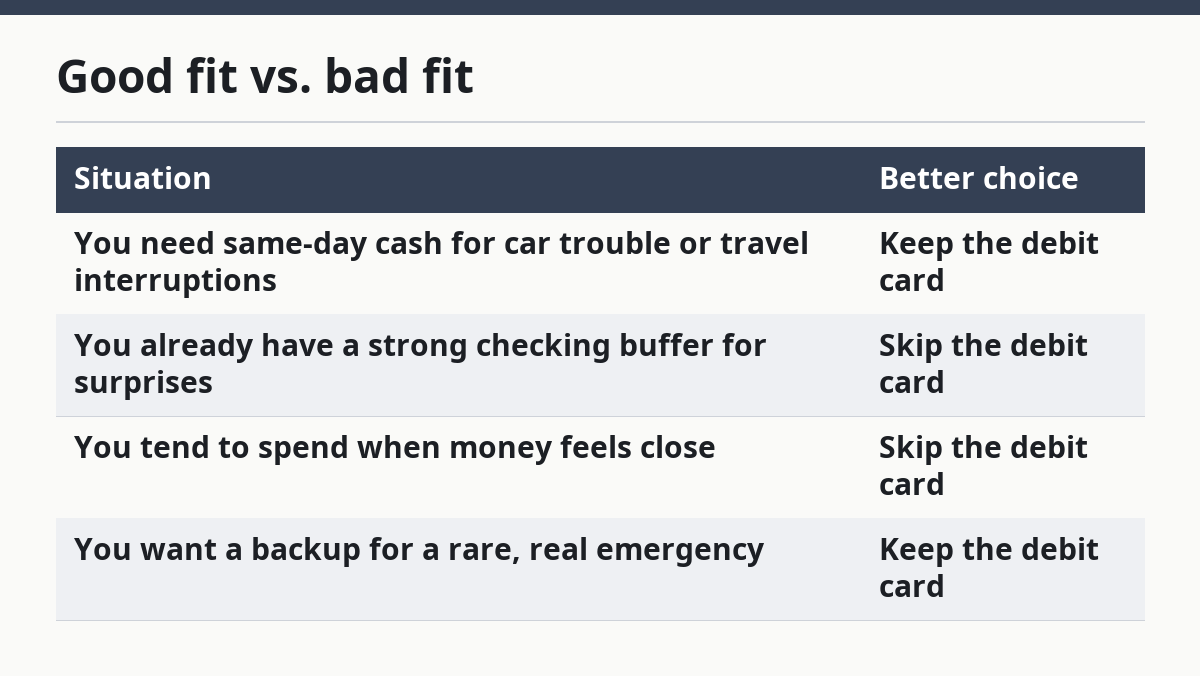
Good fit vs. bad fit
| Situation | Better choice |
|---|---|
| You need same-day cash for car trouble or travel interruptions | Keep the debit card |
| You already have a strong checking buffer for surprises | Skip the debit card |
| You tend to spend when money feels close | Skip the debit card |
| You want a backup for a rare, real emergency | Keep the debit card |
How to decide in under 5 minutes
You can decide fast if you ask four blunt questions and answer them honestly.
-
Will I need cash the same day?
If yes, card access has a real job. -
Do I already have another fast source of money?
If yes, the card may be redundant. -
Will a card make me spend from savings too easily?
If yes, the risk probably outweighs the convenience. -
Do I want this account to feel separate from daily spending?
If yes, leaving off the card keeps that boundary intact.
If you answer “yes” to the first question and “no” to the other three, a debit card belongs on the account. If the answers go the other way, keep the fund in savings without the card and use checking as the spending bridge.
That is the real decision. Not convenience alone. Not fear alone. Just whether the card helps the emergency fund do its one job without making it easier to misuse.
Should you keep the debit card or not?
The debit card belongs on your emergency fund only if same-day access matters more than extra friction. It is a useful backup for real emergencies, but it is a poor fit for anyone who wants the fund hard to touch.
If you already keep enough cash in checking for a surprise, skip the card. If your emergency plan depends on getting money from savings fast, keep it and add guardrails so it does not become an everyday spending tool.
Do I need a debit card for emergency savings?
No, you do not need one if you already have another fast way to get cash. A debit card is helpful only when the emergency fund must be spendable the same day and you do not want to wait for a transfer. If the card would blur the line between savings and spending, leaving it off is often the cleaner choice.
When is card access useful?
Card access is useful when the emergency is immediate and the bill cannot wait for a transfer. Think towing, a hotel after a home problem, or a repair shop that needs cash now. It is also useful if you travel often or you know you freeze when a problem hits and need one simple backup.
What are the risks of attaching a card?
The main risks are easier spending, extra ATM fees, and weaker separation between savings and daily cash. A card can make an emergency fund feel like an everyday account, which is how people quietly drain it. If that sounds likely, the safer move is to keep the savings account card-free and use checking for routine access.
Drafted with AI; not yet reviewed by a person.