
Last updated: November 20, 2026
Quick Answer: For How to Set an Emergency Fund Goal for a Military Family During Deployment, start with 1 month of essential expenses plus deployment-only costs and a buffer for pay timing; if deployment is longer or benefits are shaky, build toward 3 months. Deployment changes the bills, the timing, and the risk, so your emergency fund goal should match the extra gap deployment creates in your household budget.
The steps below will show how to set that goal without guessing, over-saving, or leaving your family short when pay or benefits lag.
Start by finding the emergency fund goal you actually need
How to Set an Emergency Fund Goal for a Military Family During Deployment starts with the monthly number your household truly needs, not a generic rule pulled from a finance blog. Picture this: you’re home with one paycheck, one set of keys, and a stack of bills that still show up on the 1st, the 15th, and the 25th.
The right target is your essential monthly costs plus deployment-only expenses and a small buffer for pay timing. That gives you a number you can reach on purpose instead of a vague “save more” idea. For a military family, the gap often comes from childcare changes, travel, home repairs, and delays in benefits or allowances.
Key Takeaways
- Use essential monthly expenses as the base, not every spending habit.
- Add costs tied to deployment, like child care, travel, and extra driving.
- Build in a buffer for pay or benefit delays.
- Pick a goal you can reach in 3 to 6 months if deployment is short, or stretch higher if the separation is long and the home front is on its own.
- Recheck the goal when your household setup changes.
How do you set an emergency fund goal for a military family during deployment?

Set it by combining 3 layers: the bills that keep the lights on, the costs deployment adds, and the timing problems that come with split households. That is the cleanest way to set a goal you can defend.
Because a military family during deployment is not just a family with less time together, the budget often shifts into one-adult day-to-day work plus extra costs that show up because one person is gone. The goal should reflect that reality.
-
List your basic monthly bills
Pull together housing, food, utilities, insurance, gas, minimum debt payments, and phone service. Use the amount you must pay to keep the household running, not the amount you wish you spent. -
Add deployment expenses
Include child care, lawn care, pet care, higher transportation costs, home maintenance, and travel to see family if that is part of your plan. These are often the costs that surprise people. -
Add a timing buffer
Put in enough to cover a late allotment, a pay hiccup, or a delay in benefits. Even a 1-month cushion can keep a missed payment from becoming a late fee chain. -
Set your target amount
Multiply your monthly essential costs by the number of months you want covered, then add deployment-specific expenses. The result is your working emergency fund goal. -
Write the trigger for stopping or saving more
Decide what you are protecting against: a car repair, a temporary housing issue, child care during a sudden duty shift, or a gap in pay. That keeps the fund tied to a real job.
On the flip side, don’t use your full pre-deployment spending as the target. That usually inflates the number and makes the goal feel impossible. Better to anchor the fund to necessities plus deployment strain.
What expenses should a deployed household count?
A deployed household should count the expenses that would still hurt if the next paycheck came late or a service bill jumped by $100. That means the fund needs to cover life on the home front, not just a vague sense of “extras.”
Start with the bills that stay steady for most families:
- rent or mortgage
- utilities
- groceries
- car payment and gas
- insurance
- minimum debt payments
- child care
Then add deployment-specific items. These are the ones generic advice misses:
- extra child care hours or after-school coverage
- lawn service or snow removal
- pet boarding or pet sitting
- house cleaning during busier weeks
- airfare or fuel for family visits
- replacement costs for items the deployed service member used to handle
- higher fuel use if one person now drives every errand
If you are keeping a single-parent household schedule for months at a time, some “small” costs stop being small. A $40 cleaning service or a $75 lawn bill can matter when one adult is carrying the load. That is why the goal should include realistic help, not idealized thrift.
A good test is simple: if the cost would force you to use a credit card, borrow from family, or skip a bill during deployment, it belongs in the emergency fund goal. If it is routine spending you can move around, leave it out.
How benefits and allowances affect the goal

Benefits and allowances should lower the amount you need to save only when they are steady, predictable, and already showing up in the budget. If the timing is shaky, don’t count the money twice.
The basic allowance and other military pay items can change what your family can safely cover each month. That matters, but the goal should be based on cash you can actually use when you need it. A benefit that arrives late does not pay a bill on time.
Treat uncertain money as a backup, not as the main plan, and check it with a financial counselor or installation finance office; the Consumer Financial Protection Bureau’s emergency-savings guidance is a good starting point for that kind of planning.
Use this filter:
- Count it if it arrives on a dependable schedule and you already know the amount.
- Half-count it if the amount is known but the timing is uneven.
- Do not count it if you are still waiting on approval, paperwork, or a start date.
That applies to pay disruptions too. If a deployment changes how much comes in, or when it comes in, the emergency fund goal should cover the gap until the normal flow returns. Building around the worst month, not the average one, is often the safer approach.
If you want a grounding source for the money side, the Consumer Financial Protection Bureau has plain-language guidance on emergency savings, and the military community has finance resources through installation offices and family support channels. Use those as support, but keep your target rooted in your own bills.
What changes when deployment turns one adult into the whole household?
Deployment raises the goal when one person is now handling the house, the schedule, and the random repairs alone. That is not just emotional stress; it changes the math.
When the home front becomes a one-adult operation, the emergency fund often has to do more work in 30 days than it did before. You may need paid help for child care, yard work, school pickups, or pet care. You may also lose the backup of having the other adult handle a repair, a sick day, or a sudden errand.
Common mistakes here are easy to spot:
- Underfunding child care. This can force a parent to miss work or pay rush fees.
- Ignoring home maintenance. A clogged drain or dead battery is still a bill.
- Leaving travel out. Seeing family or dealing with a home emergency away from base can cost real money.
- Counting every wish-list expense. That bloats the goal and slows saving.
Use the 3-part test: would this cost happen because deployment changed the household, would it hit in less than a month, and would it hurt if the money were not there? If the answer is yes, it belongs in the goal.
How do you turn the goal into a real number?
Turn the goal into a real number by choosing a coverage window, then pricing one month of your life on paper. That gives you a figure you can save toward instead of a guess.
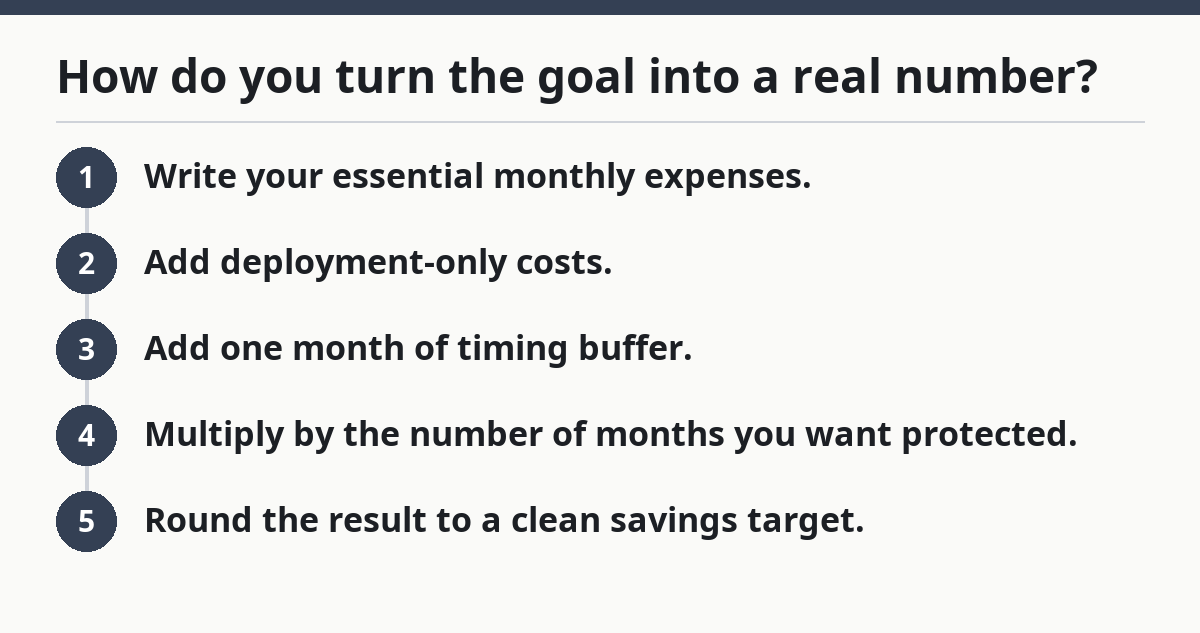
Use this simple method:
- Write your essential monthly expenses.
- Add deployment-only costs.
- Add one month of timing buffer.
- Multiply by the number of months you want protected.
- Round the result to a clean savings target.
For example, if your necessary monthly bills are one amount, deployment adds another layer of costs, and you want a 3-month cushion, your goal is the full total for those 3 months, not just a pile of cash that “feels safe.” If deployment will be long, or if pay timing is messy, you may want a larger cushion. If the deployment is short and predictable, a smaller goal may be enough to start.
That number is not permanent. It should move when your household changes. If child care ends, a debt is paid off, or a service member returns home, recalculate. If new costs appear, raise the goal before the next surprise hits.
How do you keep the goal realistic while deployment is underway?
Keep the goal realistic by reviewing it every time the household changes, not just once at the start. A target that made sense in month one can be wrong by month four.
A monthly check-in that takes 10 to 15 minutes is usually enough. Look at what you spent, what surprise costs showed up, and whether pay or benefits arrived on time. If the money kept getting used for the same kind of problem, that problem belongs in the goal, not outside it.
Use these adjustments:
- Raise the goal if you had to cover child care, repairs, or travel more than once.
- Lower the goal if a cost ended and will not return.
- Keep the goal the same if the fund is still covering the same household risk.
This is also where discipline matters. Don’t raid the fund for vacation spending, gifts, or upgrades just because the account is there. The fund has one job: protect the household when deployment makes cash flow less steady.
For a bigger framework on building emergency savings across life stages, see the main emergency fund goal setting guide on this site. This page is the deployment piece; that hub is the broader map. For related budgeting help, see the military family budget guide and the deployment money checklist page.
What should a military family include in emergency savings during deployment?
A military family should include the expenses that would cause real damage if they showed up without warning. That usually means housing, food, utilities, transportation, insurance, debt minimums, child care, and deployment-only costs like pet care or home help. If a bill would push the family to use credit or miss a payment, it belongs in the fund goal.
Does deployment change the right emergency fund target?
Yes, deployment usually changes the target because it changes the household’s costs and timing. The goal should reflect one-adult workload, added child care or home help, and any gap between bill due dates and pay or benefits timing. A standard emergency fund number may be too low if those pressures are new.
How do benefits and allowances affect the goal?
Benefits and allowances can reduce the amount you need to save only if they are reliable and already active. If they arrive late, change with paperwork, or are still being processed, they should not do the work of the emergency fund. Use them as support, not as the whole plan.
Should a deployed family save more than a typical family?
Sometimes yes, because deployment can create extra costs that a typical family does not have. The right target depends on how much one adult can cover alone, what benefits are steady, and whether the home front needs paid help. A family with stable support may need less than one handling every task alone.
Drafted with AI; not yet reviewed by a person.