How to Choose an Emergency Fund Account With a True No-Penalty

Last updated: November 20, 2026
Key Takeaways
- A true no-penalty emergency fund account lets you withdraw cash without surprise fees or access blocks.
- A true no-penalty policy means your money stays reachable when you need it.
- A savings account is often the simplest emergency cash home for most readers.
- A money market account can work well when the extra access features are useful and the rules stay clear.
Your emergency fund account needs true no-penalty withdrawal access so you can pull cash without fees, delays, or surprise restrictions.
This guide on How to Choose an Emergency Fund Account With a True No-Penalty Withdrawal Policy shows how to compare withdrawal limits, fee conditions, and transfer speed.
The right choice comes down to withdrawal limits, fee conditions, and how fast your money moves.
The steps below make that decision clear.
A financial writer who follows deposit-account rules and bank fee disclosures can judge this category without guessing.
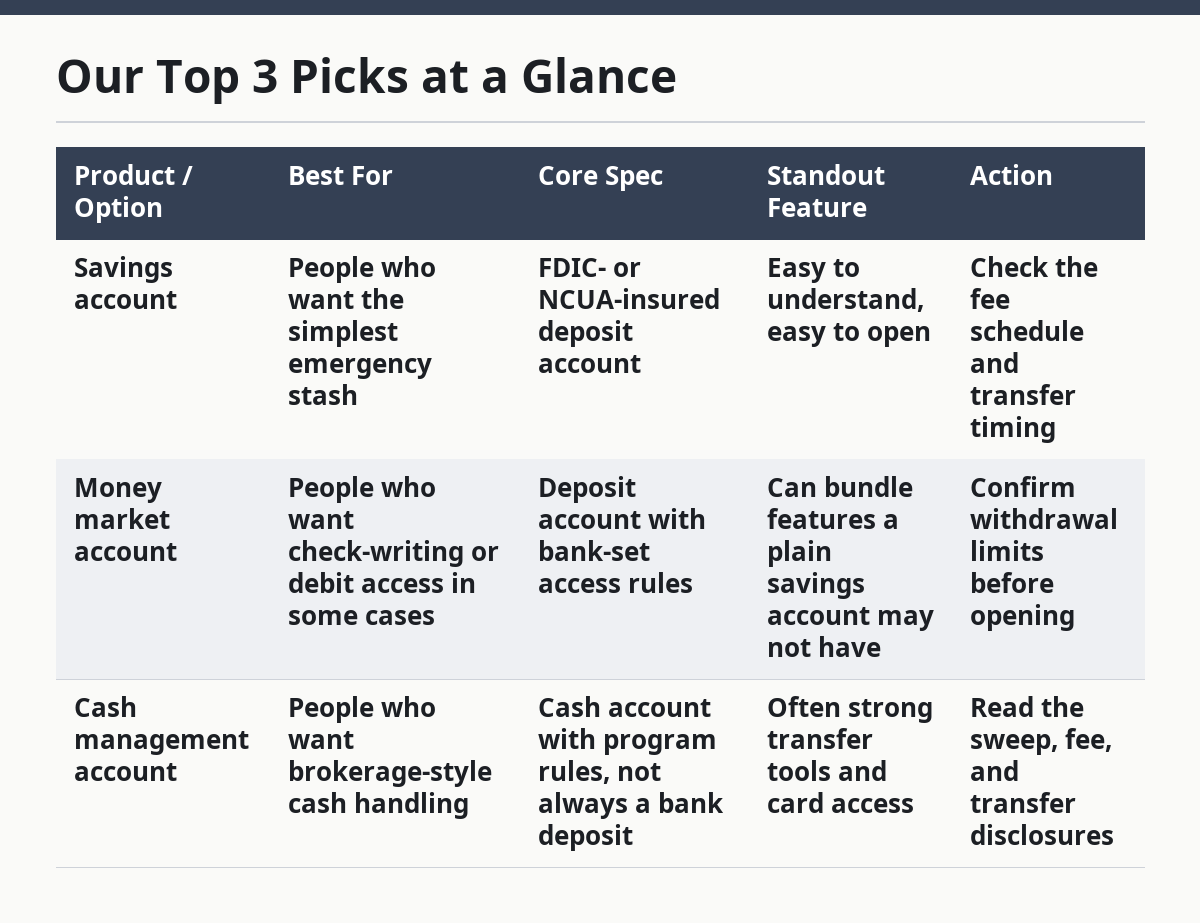
Our Top 3 Picks at a Glance

- #1 Best Overall: A savings account with no withdrawal fee, no minimum balance trap, and same-day transfer access
- #2 Best Budget Pick: A basic savings account at a bank or credit union with simple online transfers
- #3 Best Heavy-Duty / Upgrade Pick: A cash management account with broad transfer access and clear access rules
| Product / Option | Best For | Core Spec | Standout Feature | Action |
|---|---|---|---|---|
| Savings account | People who want the simplest emergency stash | FDIC- or NCUA-insured deposit account | Easy to understand, easy to open | Check the fee schedule and transfer timing |
| Money market account | People who want check-writing or debit access in some cases | Deposit account with bank-set access rules | Can bundle features a plain savings account may not have | Confirm withdrawal limits before opening |
| Cash management account | People who want brokerage-style cash handling | Cash account with program rules, not always a bank deposit | Often strong transfer tools and card access | Read the sweep, fee, and transfer disclosures |
What “true no-penalty” really means
A true no-penalty emergency fund account lets you take money out without a withdrawal fee, wire penalty, or closed-account surprise when you need cash fast.
That sounds obvious, but the fine print is where people get burned, especially with transfer delays and bank fees.
For that reason, the phrase “true no-penalty” should mean no withdrawal fee, no access penalty, and no surprise barrier when you move your cash.
- No withdrawal fee means the bank does not charge just because you moved money out.
- No access penalty means the account does not punish you with a lost bonus, closed subaccount, or rate change after a withdrawal.
- Fast transfer access means you can move cash to checking or a linked account when the bill is due.
- Clear limits mean you know whether the account caps how many withdrawals or transfers you can make.
Two official places worth checking are the FDIC deposit account guidance and the Consumer Financial Protection Bureau pages on bank fees and account access. Those are the kinds of disclosures that tell you what actually happens when you need the money.
The CFPB also tracks bank fees and account issues through consumer resources, and the FDIC explains deposit insurance basics for insured accounts.
How do I know if an emergency fund account has a true no-penalty withdrawal policy?

A true no-penalty policy is the one that does not charge you, block you, or make the money hard to reach when you withdraw.
If the account only sounds free but hides limits, holds, or service fees, it is not the right emergency fund home.
The simplest test is whether the fee sheet and access rules still look clean after you read them.
- Read the fee schedule for withdrawal, transfer, wire, and account-closing fees.
- Check the access rules for online transfer timing, ATM access, and debit card use.
- Look for withdrawal limits such as caps on transfers or linked-account moves.
- Verify the deposit insurance so your cash sits in an insured place.
- Confirm the bank fee policy on overdrafts, returned transfers, and monthly service charges.
A good emergency fund account should be boring in a helpful way.
No hidden toll booth. No surprise fee.
Savings account: the safest default for most people
A savings account is often the safest default for most people because it is the easiest place to keep emergency cash without extra rules or moving parts.
It usually gives you simple transfers to checking, plain-vanilla statements, and FDIC or NCUA insurance if the institution qualifies.
That matters more than a fancy feature list.
The strength is clarity. You can see the balance, move money when needed, and avoid the confusion that comes with layered cash programs.
The weakness is that some banks still impose monthly fees, transfer limits, or awkward waiting times on outgoing transfers.
That can turn a “simple” account into a headache.
Who Should Skip This: People who need card access, check writing, or a more flexible cash tool may prefer a money market account or cash management account instead.
A plain savings account is better when you want low friction, not extra features.
- Buy this if: you want an insured emergency fund and you move money through online transfers.
- Skip this if: you need frequent outbound payments or want to avoid banks with strict service fees.
A basic savings account often works at both a bank and a credit union, and you can usually compare options at the institution’s site, a branch, or a brokerage-linked bank partner.
According to the FDIC, deposit insurance generally covers up to $250,000 per depositor, per insured bank, for each account ownership category.
Check the current monthly fee, if any, before you open it.
Money market account: useful only if the access rules are clear
A money market account can be useful only if the access rules are clear.
It can mean check-writing, debit access, or better transaction tools than a plain savings account.
It can also mean more paperwork, more conditions, and more room for confusion.
The upside is access. For some people, a money market account makes it easier to move emergency cash without a separate checking transfer.
The downside is that the account can still carry transfer limits, minimum balance rules, or fees tied to activity and balances.
If you ignore those details, the account can look flexible and still act restrictive.
Who Should Skip This: People who want the simplest emergency stash should stay with a plain savings account instead.
A money market account is not the best fit if you dislike fee schedules or do not need check or card features.
- Buy this if: you want emergency cash with check or debit access and you are willing to read the fine print.
- Skip this if: you want a no-drama account with the fewest moving parts.
A money market account can be a strong middle ground, but only if the bank clearly states what happens on withdrawals, transfers, and excess activity.
If the rules are vague, walk away.
The CFPB’s bank-account complaint data and guidance are useful when you want to compare fee patterns across account types.
Cash management account: strong access, but read the sweep rules
A cash management account can be a strong choice for people who want broader money movement and do not mind a brokerage-style setup.
It can be a smart home for emergency cash because transfer tools are often strong and the account may bundle spending access with cash parking.
The catch is that the structure can be more layered than a standard savings account at a traditional bank.
That layered structure matters. Some cash management accounts use partner banks or sweep programs, which means the money path can be more complex than a standard savings account.
That is fine if the disclosures are clear.
It is a bad fit if you want a plain, direct emergency fund with no extra moving parts.
Who Should Skip This: People who want the simplest insured deposit account should choose a savings account instead.
A cash management account makes more sense when transfer flexibility matters more than old-school simplicity.
- Buy this if: you want wide transfer options and can live with a brokerage-style setup.
- Skip this if: you want a traditional bank account with one obvious rulebook.
Check the current monthly service charge, ATM fee, or outgoing transfer fee before you link it to your emergency fund plan.
Those are the costs that quietly change the decision.
Brokerage sweep accounts can work, but the policy details should be clear before you treat them like a plain bank savings account.
The honest side-by-side
A savings account wins for the average emergency fund because it is the clearest place to store money you may need on short notice.
Money market accounts and cash management accounts only win when the extra access features match your real life.
Here’s the comparison that matters:
| Criteria | Savings Account | Money Market Account | Winner for this condition |
|---|---|---|---|
| Withdrawal fee | Usually simple or none, but varies by bank | Can be simple or none, but rules differ | Savings account for plain withdrawal clarity |
| Transfer speed | Often straightforward online transfers | Often similar, sometimes better feature set | Tie, if disclosures are clear |
| Card or check access | Usually limited | More likely to include it | Money market account if you need direct access |
| Fee risk | Lower if the bank keeps it basic | Higher if balance or activity rules apply | Savings account for fewer surprises |
| Withdrawal limits | Can still apply | Can still apply | Tie, check the policy sheet |
| Account complexity | Low | Medium | Savings account for simplicity |
| Best fit for first emergency fund | Yes | Sometimes | Savings account |
| Best fit for frequent access | Sometimes | Yes | Money market account |
| Best fit for cash flexibility | No | Sometimes | Cash management account |
The real winner for no-penalty use is the account with the fewest conditions between you and your cash.
That is usually a basic savings account, not the flashiest one.
A cleaner fee sheet usually beats a fancier feature list.
When the verdict flips
The usual answer changes in three situations.
If your emergency fund needs to act like a spending tool, a cash management account can beat a savings account.
If you need check-writing or debit access, a money market account may be the better fit.
If your bank charges a monthly service fee unless you keep a balance you cannot reliably maintain, the account is wrong for you.
To be specific, the verdict flips when access matters more than simplicity.
- You need same-day spending access. A cash management account may beat a plain savings account if it has better transfer rails.
- You want built-in payment tools. A money market account can win when check or debit access matters.
- Your bank fees are sticky. If the savings account has a service fee, excess transfer fee, or balance rule you cannot meet, it loses.
- Your emergency fund is small. The account with the cleanest fee sheet usually beats the one with flashy features.
The truth is, the right emergency fund account is the one that keeps your cash liquid without adding a fee trap.
That is the whole game.
The verdict: which one to choose and why
Choose a savings account if you want the cleanest no-penalty emergency fund home, use online transfers, and care more about simple access than extra features.
Choose a money market account if you need check or debit access and can verify that the withdrawal rules stay friendly.
Choose a cash management account if you want broader transfer tools and can handle a more layered account structure.
Neither if the account has monthly service fees, strict balance rules, or transfer limits that would block you in a real emergency.
That is the call.
Simple wins.
Drafted with AI; not yet reviewed by a person.