Emergency Fund Ownership and Access Authorization — The Complete Guide

Last updated: November 20, 2026
If your emergency fund is in the wrong name, the wrong account, or locked behind bad access rules, it can fail exactly when you need it most. Quick Answer: for most people, one owner plus at least one documented backup access path is the right starting point for emergency fund ownership and access authorization. The sections below settle who should own the fund, who should have access, and how to set the rules without creating new risk in emergency fund ownership and access authorization.
Key Takeaways
- Put the fund in a structure that matches the real owner and the real emergency.
- Keep access easy enough for a crisis, but not so open that one bad login drains the account.
- Joint ownership, beneficiary forms, powers of attorney, and trusted contact settings do different jobs.
- A backup person should know where the money is, how to reach it, and what they are allowed to do.
- Review the setup after marriage, divorce, death, disability, or a move to a new bank.
Who should own an emergency fund?
The person who will use the money should usually own the emergency fund, because ownership controls who can withdraw, close, or retitle the account. That sounds obvious, but it gets messy fast when couples, parents, adult children, and caregivers all think they “have access.”
Picture this: you need rent money released today, but the account is in someone else’s name and the bank won’t move on a text from a family member. Ownership decides control, and control decides speed. A savings account with the right name on it is far safer than a “shared understanding” that no one can prove.
Common ownership setups include:
- Single owner: one person owns the account and keeps full control.
- Joint owners: two people each have withdrawal rights and may each be able to close the account.
- Trust ownership: the fund sits in a revocable or irrevocable trust, with the trustee controlling access.
- Business or estate accounts: these are not for a personal emergency fund unless the emergency is tied to that entity.
The wrong setup often looks tidy on paper and ugly in a real crisis. A parent named as owner on a child’s “emergency fund” may control the money today, then trigger tax, inheritance, or creditor problems later. A spouse listed as an informal helper may have no legal right to touch the account at all.
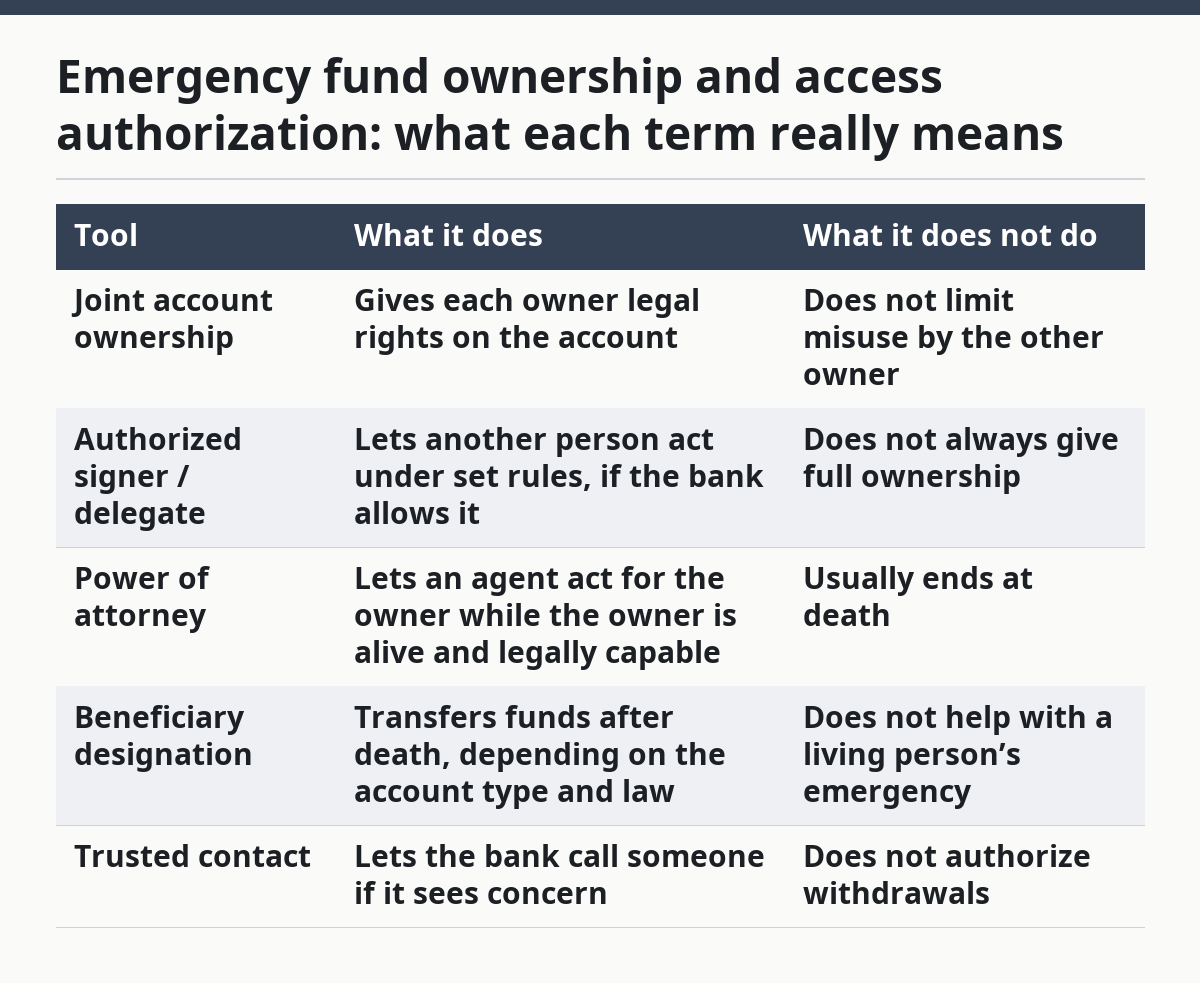
Emergency fund ownership and access authorization: what each term really means
Emergency fund ownership and access authorization are not the same thing, and mixing them up causes most problems. Ownership answers who the money belongs to; authorization answers who may reach it and under what rules.
Picture this: the bank recognizes your name, but the person sitting next to you has a debit card, a password, and a story about an emergency. If the account agreement does not allow that person in, the bank still says no. Access authorization is a permission layer, not a magic shortcut.
Here are the main tools people confuse:
| Tool | What it does | What it does not do |
|---|---|---|
| Joint account ownership | Gives each owner legal rights on the account | Does not limit misuse by the other owner |
| Authorized signer / delegate | Lets another person act under set rules, if the bank allows it | Does not always give full ownership |
| Power of attorney | Lets an agent act for the owner while the owner is alive and legally capable | Usually ends at death |
| Beneficiary designation | Transfers funds after death, depending on the account type and law | Does not help with a living person’s emergency |
| Trusted contact | Lets the bank call someone if it sees concern | Does not authorize withdrawals |
The best structure depends on the problem you are trying to solve. If the issue is “I need someone to pay bills if I’m hospitalized,” a power of attorney may matter more than joint ownership. If the issue is “my spouse needs to move money fast without asking permission every time,” joint ownership may fit better.
How to set up access without giving away control
You can make an emergency fund reachable without making it reckless. The trick is to separate day-to-day access, backup access, and ownership rights, then keep each one narrow.
Picture this: you want a partner, adult child, or caregiver to be able to pay a deductible at 9 p.m., but you do not want them emptying the account because they know the login. A bank account with clear rules beats a password in a text thread. Give access by role, not by habit.
A practical setup usually includes:
-
Primary owner on the account.
Keep the fund in the name of the person who should control it by default. -
Written backup instructions.
Leave a plain-English note with the bank name, last four digits of the account, and where the emergency card or checkbook is kept. -
A legal backup document if needed.
For long hospital stays, dementia planning, or chronic illness, a durable power of attorney can matter more than informal family access. -
A second place for liquidity.
A linked checking account, money market account, or cash reserve can make the first 24 hours easier. -
A one-time rule for “what counts as an emergency.”
Name the trigger: job loss, urgent home repair, medical bill, travel to care for family, or temporary income disruption.
A few hard truths belong here. If the backup person has the online password, they may have more practical power than the bank intended. If they are also a joint owner, they may be able to drain the account before anyone notices. If you need strict limits, ask the bank whether it offers a delegate or view-only role before defaulting to joint ownership.
Joint accounts, beneficiaries, and powers of attorney: which one fits?
The right tool depends on whether the person is helping while you are alive, after you die, or only in a narrow emergency. Those are three different jobs, and one form rarely solves all three.
Picture this: you are comparing forms that all sound legal but do very different things. One gives access now, one passes money later, and one only helps if the bank accepts the document. Choose the tool for the timing, not for the label.
Joint account ownership
A joint account gives both owners legal rights during life, and in many banks either person can withdraw money without asking the other first. That speed is the benefit. The risk is plain: one owner can spend the fund, freeze the account by dispute, or create tax and creditor issues depending on local law.
Beneficiary designation
A beneficiary helps after death, not before. It can be useful for transfer-on-death or payable-on-death account structures where the bank honors the form and the law allows it. It does nothing for a living owner who needs the money for surgery, rent, or a sudden layoff.
Durable power of attorney
A durable power of attorney lets an agent handle financial tasks while the owner is alive, even if the owner becomes unable to manage affairs. That makes it a strong fit for illness planning. It can also be misused if the agent is not trustworthy, so banks often want the document in their own format or with specific wording.
A single-owner emergency fund with a durable power of attorney and a trusted contact can be cleaner than a joint account if the goal is to preserve control. A married couple who treats the fund as truly shared may prefer joint ownership, but only if both people understand the downside and, if needed, confirm the setup with the bank or an attorney familiar with local rules.
What the bank will actually let someone do
A bank will only honor the authority it recognizes in its own system, and that system is stricter than most families expect. A person may know the login, know the account number, and still be blocked from moving money if they are not on the account agreement.
Picture this: you are at a branch with a folder full of documents, but the teller still has to follow the account title and bank policy. That is not rudeness; it is the rulebook. The bank follows paperwork, not family consensus.
Common bank-controlled access limits include:
- Online banking credentials: useful, but often weak if shared informally.
- Debit card access: fast for purchases, risky if the card is lost or copied.
- Branch withdrawal authority: may require ID and account ownership.
- Wire or ACH permissions: usually stricter than cash withdrawals.
- Card controls and alerts: helpful for fraud detection, not a substitute for authority.
If you want a backup person to help, ask the bank these direct questions:
- Can this account have a trusted contact?
- Can it support a power of attorney on file?
- Does joint ownership mean either person can close the account?
- Are there limits on cash withdrawals or transfers?
- What documents are required if the owner is hospitalized or unavailable?
The consumer finance side of this is worth checking with the Consumer Financial Protection Bureau and the specific bank’s account agreement. If the fund is tied to estate planning or incapacity planning, a local attorney or estate planner can help match the document to the account type. That is not overkill. It is the difference between “should work” and “did work.” See also the CFPB’s guidance on powers of attorney and the FDIC for deposit account rules.
How to protect the fund from misuse while keeping it reachable
You protect an emergency fund by making it easy to reach for the right reason and hard to raid for the wrong one. That means limiting the size of the balance in the most accessible account and using alerts, not blind trust.
Picture this: the account is open, the emergency is real, and the question is whether someone can move $800 without creating a mess. A little friction is good if it stops theft, fraud, or a panicked impulse. Access should be fast, not loose.
A safer setup often includes:
-
Alerts for every withdrawal or transfer.
Set text or email alerts for debits over a chosen amount. -
Separate logins for separate people.
Shared passwords make it hard to prove who did what. -
Only one or two trusted backers.
The more people who can touch the fund, the weaker the controls. -
A low-friction but not unlimited account.
A savings or money market account is usually better than keeping cash in the home. -
A reviewed paper trail.
Keep a copy of the account title, bank phone number, and access documents in a safe place.
A common mistake is putting every spare dollar in the easiest account to touch. That turns a safety cushion into spending money. Another mistake is hiding the account so well that no one can find it during a real emergency. Both are bad. The middle path is better. For basic account security, the FDIC and Federal Reserve both recommend keeping records, monitoring activity, and protecting credentials.
Special cases: couples, caregivers, adult children, and solo savers
Different family setups need different access rules, and the wrong structure can create either delay or legal risk. The setup that works for a married couple may be a bad fit for an older adult with one reliable child, and both may be wrong for a solo saver with no household partner.
Picture this: you are trying to plan for a hospital stay, a divorce, a parent’s illness, or a move across state lines. The account that felt simple last year can become a problem fast. The best structure changes with the household, and it should be reviewed against the actual account rules.
Couples
A couple often does best with either true joint ownership or a single owner plus a documented backup. If both people earn income and share bills, joint ownership can speed emergency payments. If one person handles all money and the other only needs backup access, a power of attorney may be cleaner.
Caregivers and adult children
If an adult child helps an older parent, the child should not assume they can touch the account just because they are “the responsible one.” A caregiver can be named in legal documents, but the bank still needs the right form on file. Without that, even a simple bill payment may stall.
Solo savers
A single person should not put the fund in a friend’s name just to make it “easy later.” That invites ownership disputes, tax problems, and bad timing if the relationship changes. A solo saver is usually better off with a direct bank structure, a durable power of attorney, and clear instructions stored where the agent can find them.
Blended families
Blended families need extra care because “my money,” “our money,” and “the kids’ money” are not the same thing. A named beneficiary on one account does not solve current access. A revocable trust may be better for larger funds, but that is a planning move, not a casual banking choice.
Red flags that the setup is wrong
A bad emergency fund setup usually gives itself away before there is a crisis. The warning signs are visible in the account title, the login habits, or the story people tell themselves about who “can get to it if needed.”
Picture this: you are relying on memory, a shared note, and one family member’s goodwill. That feels efficient until the day it doesn’t. If the plan only lives in someone’s head, it is not a plan.
Watch for these problems:
- The fund is in the wrong person’s name.
- Two people use one login, and nobody can prove who moved money.
- The backup person has no legal document and no bank recognition.
- The account is too easy to drain, so the first crisis turns into a second one.
- No one has checked the setup after marriage, divorce, death, or relocation.
A useful test is simple: if the owner were out of contact for 72 hours, could the right person still reach the money without a court order? If the answer is no, the setup is too fragile. If the answer is yes because anyone with a password can empty it, the setup is too loose.
The same test works in reverse. If the fund is so locked down that nobody can move $500 for a hotel, prescription, or rent deposit, it is not serving its job.
How often should you review ownership and access?
You should review emergency fund ownership and access authorization at least once a year and after any major life event. That includes marriage, divorce, birth, death, moving states, a new diagnosis, a new caregiver, or a switch from a personal account to a household account.
Picture this: the account was set up three years ago, before the spouse change, the bank merger, and the new power of attorney. Old paperwork often survives long after the family story changes. Annual review keeps stale access from becoming a trap.
A simple review takes less than an hour:
- Confirm the named owner.
- Confirm who can withdraw money.
- Check whether the bank still has the latest legal forms.
- Make sure the trusted contact is current.
- Store the latest instructions in a place the backup person can reach.
If the account is part of a bigger estate or incapacity plan, review it with the rest of the documents. A will does not control a bank account in the same way a beneficiary form does, and a power of attorney may not be enough for every bank. That is exactly why a yearly check matters.
Questions people ask when setting this up
Can a trusted contact withdraw money from my emergency fund?
No, a trusted contact usually cannot withdraw money unless they are also an owner or authorized user under the bank’s rules. The trusted contact role is mainly for safety and fraud concern, not for direct control. If you want someone to move money, that person needs real authorization.
Is a joint account the easiest way to share emergency access?
Yes, a joint account is often the easiest way for two people to share direct access, because either owner may be able to move money right away. The trade-off is that both people usually have broad control, which can be risky if trust is uneven or one person has creditor issues.
Does a power of attorney help with an emergency fund right away?
Yes, a durable power of attorney can let an agent handle the account while the owner is alive, if the bank accepts the document and the wording is right. It does not give post-death rights, and it is only as good as the bank’s file and the law that governs it.
Should I keep my emergency fund in cash so someone can access it fast?
No, large amounts of cash create theft, loss, and replacement problems, and they do not leave much of a record. A bank account with clear authorization is usually safer, especially if you want both access and traceability. Small cash is fine for immediate needs, but not as the main fund.
What is the safest setup for a single person with no spouse?
A safer setup is usually a personal account in the owner’s name, with a durable power of attorney, a trusted contact on file, and clear written instructions for the backup person. That keeps ownership clean while still giving a helper a lawful path in a real emergency.
Drafted with AI; not yet reviewed by a person.