Emergency Fund Type and Feature Selection — The Complete Guide

Last updated: November 20, 2026
Quick answer: for most people, the best emergency fund account is an insured high-yield savings account with no monthly fee and access in 1 to 3 business days. In the guide on Emergency Fund Type and Feature Selection — The Complete Guide, the right account is less about the label and more about safety, quick access, and a yield that does not disappear after fees.

Key takeaways
- Pick the account that keeps the money easy to reach in 1 to 3 business days, not the one with the fanciest name.
- For many people, a high-yield savings account is simpler than a money market account because it usually has fewer moving parts.
- A money market account can be useful if you want checks or a debit card, but those perks can come with balance rules or monthly limits.
- The safest setup is an insured deposit account, not a product that tempts you to chase return at the cost of access.
- The best emergency fund is the one that still works when you are stressed, busy, and trying not to make a mistake.
What is the best type of emergency fund account?

The best answer for Emergency Fund Type and Feature Selection — The Complete Guide is an insured deposit account that keeps cash safe, liquid, and separate from day-to-day spending. For most people, that means a high-yield savings account or a money market account, with the better choice driven by access features rather than a huge rate gap.
An emergency fund is not an investment account. It should be there for a roof leak, a job loss, a medical bill, or a car repair, not for long-term growth. That is why the right account usually trades some yield for stability and fast access.
A useful target is 3 to 6 months of core expenses, although the right amount depends on income stability, rent, debt, and family size. If the money sits in a cash account, the job is to preserve the principal and make the transfer easy when life turns noisy.
For safety, the account should be insured by a federal deposit insurer. In the U.S., that usually means FDIC insurance for banks or NCUA share insurance for credit unions. See the FDIC and NCUA for the rules that govern deposit insurance: FDIC and NCUA. For a plain-language explainer, see the related guide on FDIC insurance basics.
A small example helps. If your essential monthly spending is $2,500, then 3 months is $7,500 and 6 months is $15,000. That is the scale at which the account choice starts to matter, because fees, transfer speed, and balance rules can change the real value of the fund.
High-yield savings or money market?
A high-yield savings account is often the simpler choice, while a money market account is worth a look if you want extra payment tools or already bank at a place with a strong money market option. The label matters less than the exact features, fees, and access rules tied to the account.
Here is the practical comparison.
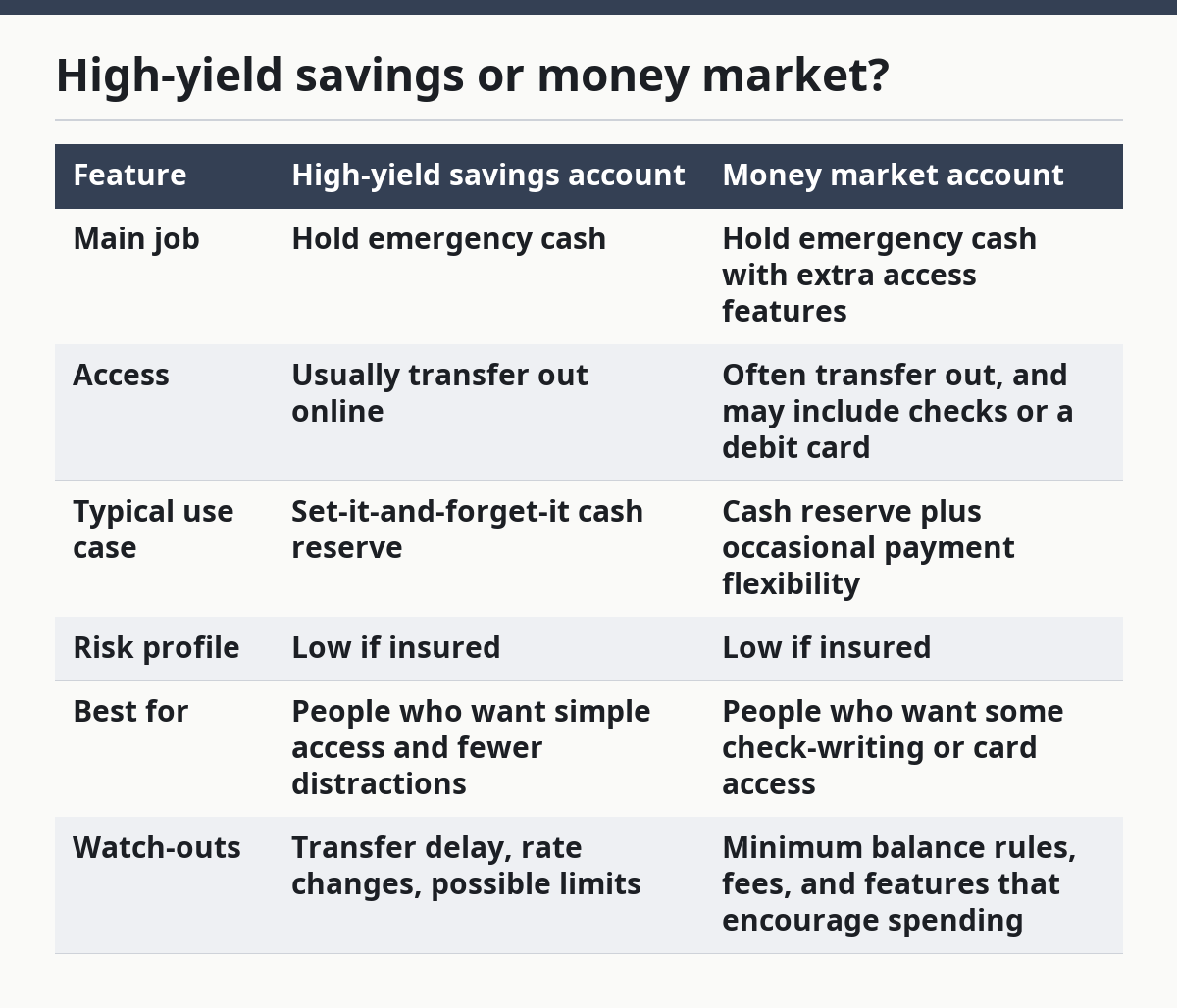
| Feature | High-yield savings account | Money market account |
|---|---|---|
| Main job | Hold emergency cash | Hold emergency cash with extra access features |
| Access | Usually transfer out online | Often transfer out, and may include checks or a debit card |
| Typical use case | Set-it-and-forget-it cash reserve | Cash reserve plus occasional payment flexibility |
| Risk profile | Low if insured | Low if insured |
| Best for | People who want simple access and fewer distractions | People who want some check-writing or card access |
| Watch-outs | Transfer delay, rate changes, possible limits | Minimum balance rules, fees, and features that encourage spending |
A high-yield savings account often works best for a reader who wants one place to park 3 to 6 months of expenses and forget about it. It usually keeps the emergency fund one step away from impulse spending, which is the point. For a deeper comparison, see high-yield savings accounts.
A money market account can make sense if the emergency fund must sometimes pay a landlord, contractor, or medical office directly. Some money market accounts also offer debit cards or checks, which sounds convenient but can make the fund easier to raid for non-emergencies.
That convenience is the main trade-off in Emergency Fund Type and Feature Selection — more access features help in a true emergency, but they also reduce the friction that protects the money from ordinary spending.
Which features matter most?

The most important features are insurance, transfer speed, fees, balance rules, and limits on withdrawals or payments. A better rate does not help if the account charges a monthly fee or locks the money behind a hard minimum balance.
Start with insurance. If the institution is FDIC- or NCUA-insured, the account is built for cash storage, not speculation. That is the first filter because no rate is worth more than the loss of principal protection. If you want a broader comparison of account types, see the guide to savings account features.
Next, look at transfer speed. An emergency fund should be reachable in a day or two, and many people can live with 1 to 3 business days. That is slow enough to stop impulse purchases but fast enough for a real car repair or utility bill.
Then check the fee schedule. A monthly maintenance fee can quietly eat the yield on a small balance. A fee is especially painful if the account is supposed to hold a modest starter emergency fund of $500, $1,000, or another small amount that is still growing.
Balance rules matter too. Some accounts require a minimum opening deposit or a minimum daily balance to avoid fees. If the balance is still building, a high minimum can turn a good account into a bad one.
Finally, check how the account moves money. Savings accounts often rely on linked transfers, while money market accounts may offer check writing or a debit card. Those features sound useful, but they should be there for rare events, not regular spending.
For comparison shoppers, the cleanest feature set is usually: no monthly fee, no minimum balance you cannot comfortably keep, 1 to 3 business day transfers, and one simple path back to checking. That combination often matters more than a slightly higher advertised APY.
How do I choose the right account for my situation?
The right account depends on how much cash you have, how often you might need it, and how likely you are to spend it if it sits too close to checking. A simple rule is to choose the account that gives you enough access without giving you too much temptation.
If the fund is small, a basic high-yield savings account is often easier to manage. A small balance can get crushed by monthly fees or balance requirements, so simplicity matters more than a few basis points of yield. For many readers, the first priority is just to separate the reserve from everyday money.
If the fund is larger and you want extra access tools, a money market account may be useful. Check writing can help if you need to pay a repair shop, contractor, or school bill by paper check, but it also makes the account feel more like checking, which can be a problem for impulse control. If you use a bank or credit union app often, the convenience may be enough to justify the extra features.
If you keep your main bank relationship at a credit union, a money market share account may fit well with the rest of your setup. If you bank online and want a clean digital bucket for cash, a high-yield savings account may be the easier home.
A good choice also depends on where your emergency money lives today. If the cash is mixed into checking, the first move is often to separate it into its own account, even before chasing a higher rate. That separation gives the fund a job and gives your checking account a different job.
Because of that, the best account is often the one that you can open quickly, fund once, and leave alone. That is especially true if you are still building the reserve and do not want to manage another complicated product.
What features should I avoid?
The features to avoid are fees, confusing minimums, payment tools you do not need, and anything that makes the emergency fund harder to reach on a weekend or a holiday. A good emergency fund account should feel plain, not clever.
Watch out for monthly maintenance fees. If the account charges a fee unless you keep a larger balance, the emergency fund may be working against itself during the months when every dollar matters most. For example, a $5 monthly fee is $60 a year, which is meaningful on a $1,000 starter fund.
Avoid teaser rates that disappear later. A rate looks attractive for a short time, but an emergency fund is usually a long-term holding tank, so the steady rate matters more than the opening gimmick. A temporary bump is not worth the trouble if the account later becomes a poor fit.
Avoid accounts that blur the line between savings and spending. A debit card tied to the emergency fund can be useful in a real crisis, yet it also makes the money easier to spend on things that are not emergencies.
Also avoid accounts with slow or awkward transfer rules if your life depends on speed. If a transfer needs several steps, or if the account has odd cutoff times, the money may be there on paper but not there when the bill is due. For a checklist you can use before opening one, see the bank account comparison guide.
When the account comes with extra temptations, the issue is not the feature itself but the way the feature changes behavior. The point of Emergency Fund Type and Feature Selection is to make the reserve available without making it inviting.
How should I build the fund itself?
The safest way to build the fund is to keep the first dollar in an insured account and grow toward 3 to 6 months of essential expenses. That target is flexible, but the structure should be firm: separate account, clear purpose, and no mixing with routine spending.
A small starter fund still matters. Even $500 or $1,000 can stop a bad week from becoming a debt cycle, especially if the emergency is a tire, a prescription, or a broken appliance. If your budget is tight, building the first $1,000 is often the fastest way to make the account useful.
If income is unstable, the account choice matters even more. The fund needs to be easy to reach, and the bank or credit union should not make you wait through a maze of steps to move cash during a real gap in pay. A gig worker, a commission worker, or a seasonal worker may place a higher value on speed than on a tiny rate difference.
Many people do best with one emergency account and one spending account. That separation reduces mistakes and makes it easier to see whether the reserve is growing or shrinking.
A useful habit is to treat the emergency fund like insurance, not savings for a future purchase. If the account balance keeps getting spent on vacations, gadgets, or holiday shopping, the account type is not the real problem. The purpose is.
For long-term discipline, automate small transfers until the balance reaches your target. Then stop or slow the transfers and let the account sit. That rhythm keeps the fund alive without turning it into another place to shuffle money for no reason.
When is a money market account the better pick?
A money market account is the better pick when you value check writing or debit-card access more than absolute simplicity. That can be a good trade if you know you will occasionally need to pay a bill directly from the emergency fund.
It can also help if your bank or credit union offers a strong money market account with no fee, a low minimum, and a rate that is close to the best savings option. In that case, the difference may come down to convenience rather than return.
A money market account is not automatically better just because it sounds more financial. Some versions come with balance hurdles or more complex rules, and those can be a poor fit for a small or newly built emergency fund.
It is also not the best pick for someone who struggles to leave money alone. The extra payment tools may create the illusion that the account is still “safe” while making it easier to spend the cash before a true emergency arrives.
For readers who want one account to do a few jobs, a money market account can be a practical compromise. For readers who want the least temptation, a simpler savings account usually wins.
What does a good emergency fund setup look like?
A good emergency fund setup is one insured account, one clear purpose, and one simple access path. That setup keeps the money ready without making it so easy to spend that the reserve disappears before the crisis.
For a basic version, a high-yield savings account works well if you want low friction and easy online transfers. For a slightly more flexible version, a money market account can work if you want checks or card access and the fees stay at zero or near zero.
The account should not be the place where you chase return. An emergency fund’s job is to be available in 1 to 3 business days, not to produce the highest possible yield in the market.
The account should also fit the size of the fund. A small balance needs a fee-free home, while a larger reserve may justify a feature set that saves time in an actual emergency.
For example, a $2,000 fund with a $4 monthly fee loses $48 a year, which is enough to matter when the account is only there to protect cash. A slightly better APY is not enough to fix a poor fee structure.
If you want a system view, the setup usually works best when the emergency fund sits apart from checking, is easy to name in your app, and is simple enough that you can explain it to yourself in one sentence.
What should I compare before opening one?
The most useful comparison is not rate alone but rate, fee, minimum, access, and insurance together. A difference of a few basis points means little if one account has a monthly fee or a balance rule that you cannot comfortably meet.
Here is the short checklist to compare before opening an account:
- Is it FDIC- or NCUA-insured?
- Is there a monthly fee?
- Is there a minimum opening deposit or minimum balance?
- How long do transfers take: same day, 1 business day, or 2 to 3 business days?
- Does it include checks, a debit card, or both?
- Does the account make it easier to save or easier to spend?
That checklist is enough for most people. If two accounts look close, the one with fewer fees and fewer temptations usually wins.
A rate change is normal, so the account should be chosen for fit, not for a short-lived headline number. Emergency money is slow money by design.
If you are comparing two nearly identical accounts, the better one is usually the one with the simpler interface, the cleaner fee schedule, and the fewer reasons to touch the balance.
FAQ
Is a high-yield savings account better than a money market account for an emergency fund?
Usually yes, because it is simpler and easier to use for pure storage. A money market account becomes better only when you need features like checks or a debit card and the fees stay low.
Can I keep my emergency fund in checking instead?
You can, but checking is usually too easy to spend from. A separate insured savings-style account adds a layer of friction that helps keep the money untouched for a real emergency.
Should my emergency fund earn interest?
Yes, if the account is still safe and easy to access. Interest is a bonus, not the main goal, so a slightly higher rate should never be the reason to choose a harder-to-use account.
How quickly should I be able to get the money?
A good target is 1 to 3 business days for an ordinary transfer. That is fast enough for many emergencies and slow enough to keep the money from becoming casual spending cash.
Is it a problem if my emergency fund has a debit card?
It can be. A debit card helps in a true emergency, but it also lowers the barrier to spending, so it is best for people who can keep firm boundaries around the account.
How much should I keep in the account?
A common target is 3 to 6 months of core expenses, but the right number depends on how stable your income is and how much of your budget is fixed. A $7,500 fund and a $15,000 fund can both be right for different households.
The cleanest choice for most people
The cleanest choice for most people is a high-yield savings account with no fee, no awkward minimum, and a transfer path that works in 1 to 3 business days. A money market account is a good second option when extra access tools matter more than simplicity.
The right emergency fund account should do three jobs well: protect the cash, keep it available, and stay out of the way. If an account fails any one of those jobs, it is not the right home for the fund, no matter what the label says.
For the topic of Emergency Fund Type and Feature Selection — The Complete Guide, that means choosing the account you can trust on a bad day, not the one that looks best on a product page.
Drafted with AI; not yet reviewed by a person.